
Table of contents
- Introduction: The Untold Science Behind Every Turban
- Types of Fabrics Commonly Used for Sikh Turbans
- The Hidden Factors That Impact Turban Comfort
- Why Some Turbans Stay Fresh All Day — And Others Don’t
- How Fabric Quality Affects Turban Style & Appearance
- Common Mistakes People Make When Choosing Turban Fabrics
- Fabric Myths Debunked by Sikh Accessories’ Experts
- How Sikh Accessories Tests Every Fabric Before Listing It
- What Makes Sikh Accessories’ Fabric Superior to Local Market Options
- Choosing the Right Fabric for Different Turban Styles
- Fabric Care Secrets Shared by Sikh Accessories
- Behind-the-Scenes
- The Best Fabrics for 2026
- Conclusion
What Most People Don’t Know About Turban Fabrics — Revealed by Sikh Accessories’ Experts
Introduction: The Untold Science Behind Every Turban
Many people assume that a turban is just a piece of clothing that wraps around the head but actually what type of fabric is used will greatly affect how comfortable the turban feels to wear, how the turban looks, and ultimately how long it lasts. An extremely lightweight cotton turban will help keep you cooler in hotter climates however one made from thicker materials would provide more stability for the Dumalla style of turban.
In working with fabric specialists and conducting research of turban fabrics Sikh Accessories learned many interesting facts regarding turban materials which many individuals may not have considered. Many factors play a role in how one experiences a turban: the thread count & type of weave determines tightness, how colour/dyes react with perspiration is another factor and there are many other variables that can change an individual’s experience of their turban. By understanding these elements, it allows Sikhs to make more informed decisions, especially when purchasing items through the Internet.
The Basics: Types of Fabrics Commonly Used for Sikh Turbans
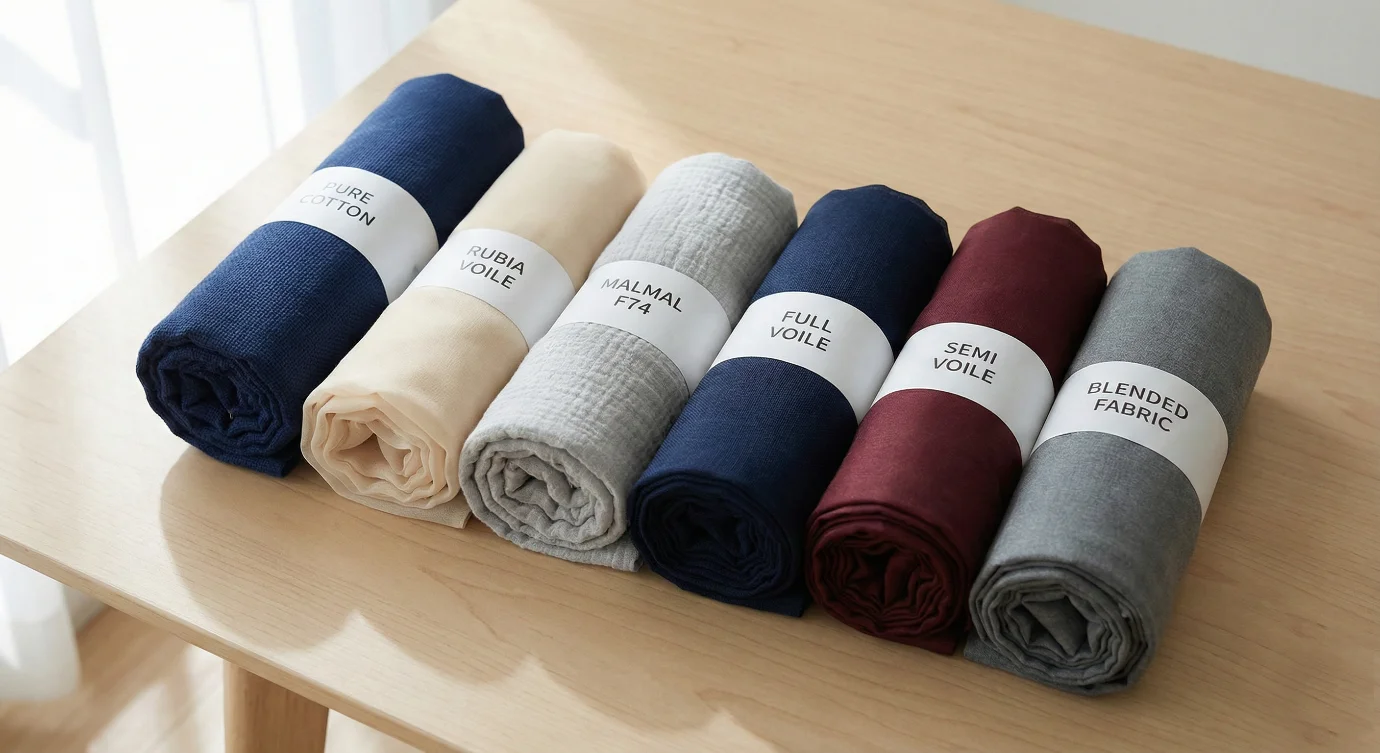
Most buyers search for turban fabrics and purchase turbans online from Sikh Accessories because the detailed content — including fabric specifications such as thread count and GSM — helps them determine whether the fabric meets their needs before making a purchase.
Pure Cotton
Pure cotton is soft, breathable and natural, and is very gentle on your scalp and therefore suitable for all types of sensitive skin. When searching for Turbans Online, many buyers discover that the daily-wear style of Turbans often consists of pre-washed premium cotton to provide low shrinkage and durability, as well as outstanding softness over time.
Rubia Voile
Rubia Voile, like other lightweight fabrics, can be styled into neat, sharp styles, and is most often used with Patiala Shahi or Nok turbans. When browsing online for Fabrics, Turbans Online website provides product information such as tightness of the weave and the level of softness to assist buyers in the selection of a fabric that best matches their preferences.
F74 / Malmal
Malmal is a lightweight and airy option ideal for warm weather or everyday use. Online fabric listings typically describe Malmal as highly breathable and easy to fold, giving users a clear idea of how it will behave in different seasons or climates.
Full Voile vs Semi Voile
While full voile offers a softer feel, semi-voile provides a stiffer texture, which can add stability and structure (especially when wearing larger turbans or Dumalla styles) compared to full voile. Therefore, the decision between full or semi-voile depends on personal preference for either a softer or more stable fabric.
Blended Fabrics
The Hidden Factors That Impact Turban Comfort
1. Thread Count
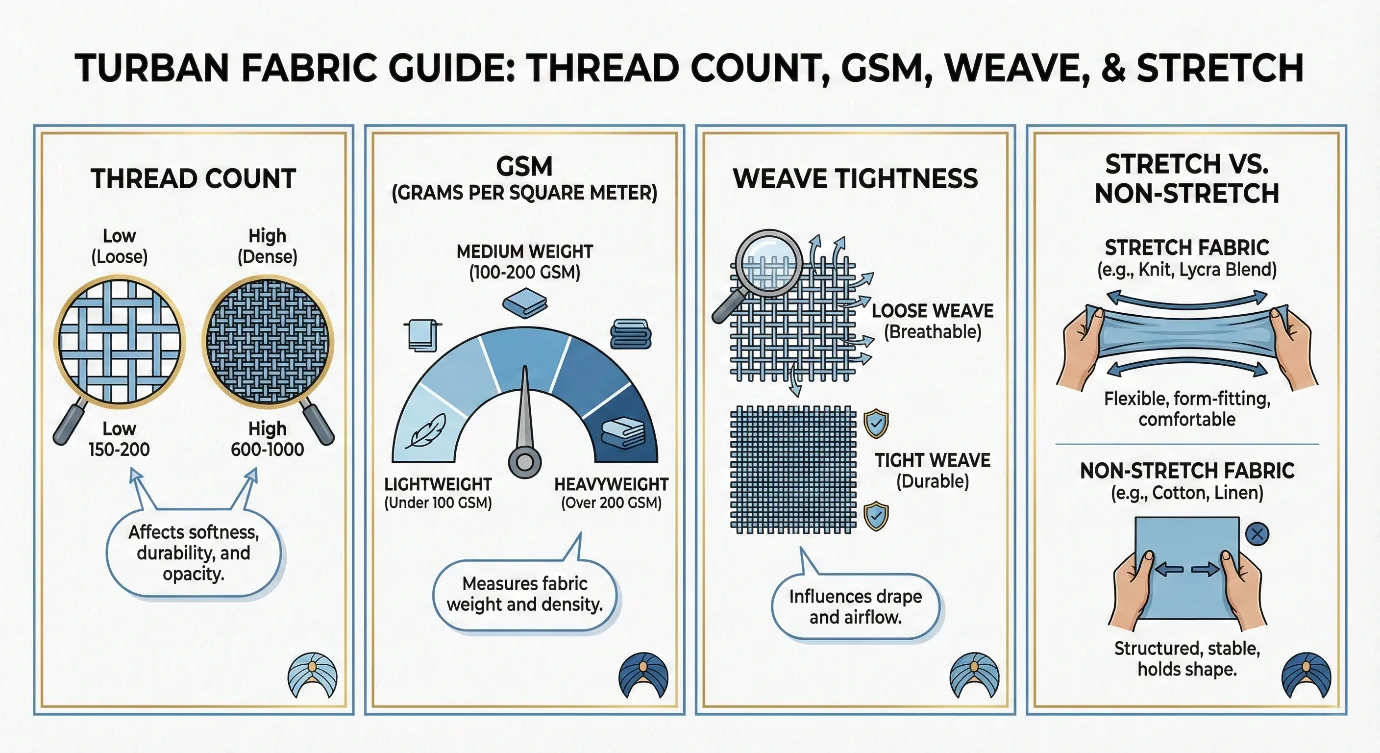
The number of threads in a square inch of fabric is defined as “thread count.” When purchasing fabric, higher counts provide an opportunity for smoother and softer experiences, whereas lower counts will generally result in roughness of touch and experience. A pleasant feeling turban is created with a larger number of threads, offering softness throughout the day.
2. GSM (Fabric Weight) and Breathability
GSM is the number of grams per square meter or GSM is an indication of the weight of a certain fabric; the lower the GSM, the airier (feels less dense) the fabric is going to be. Fabrics with a higher GSM are going to feel heavier (denser) than those with a low GSM number. Understanding these numbers can help determine the best option for everyday clothing or any occasion.
3. Weave Tightness & Softness
The use of tightly stretched woven fabric is important in terms of creating sharp edges defined by formal styles. Loosely woven fabric provides added softness, comfort and feels more natural; however, due to the reduced structure of the fabric when tied, it is less stable than tightly woven fabrics.
4. Stretch or Non-Stretch
Why Some Turbans Stay Fresh All Day — And Others Don’t
1. Moisture Absorption
Good moisture-absorbing fabrics do not cling and remain odorless. Lightweight cotton and Malmal outperform others in this area.
2. Airflow / Ventilation
Better airflow through fabrics keeps heat from escaping and allows for cooling on warm days.
3. Temperature Regulation
Lightweight fabrics work well for summer months while thicker fabrics offer insulation properties that preserve body heat against winter weather.
4. Dye Quality
How Fabric Quality Affects Turban Style & Appearance
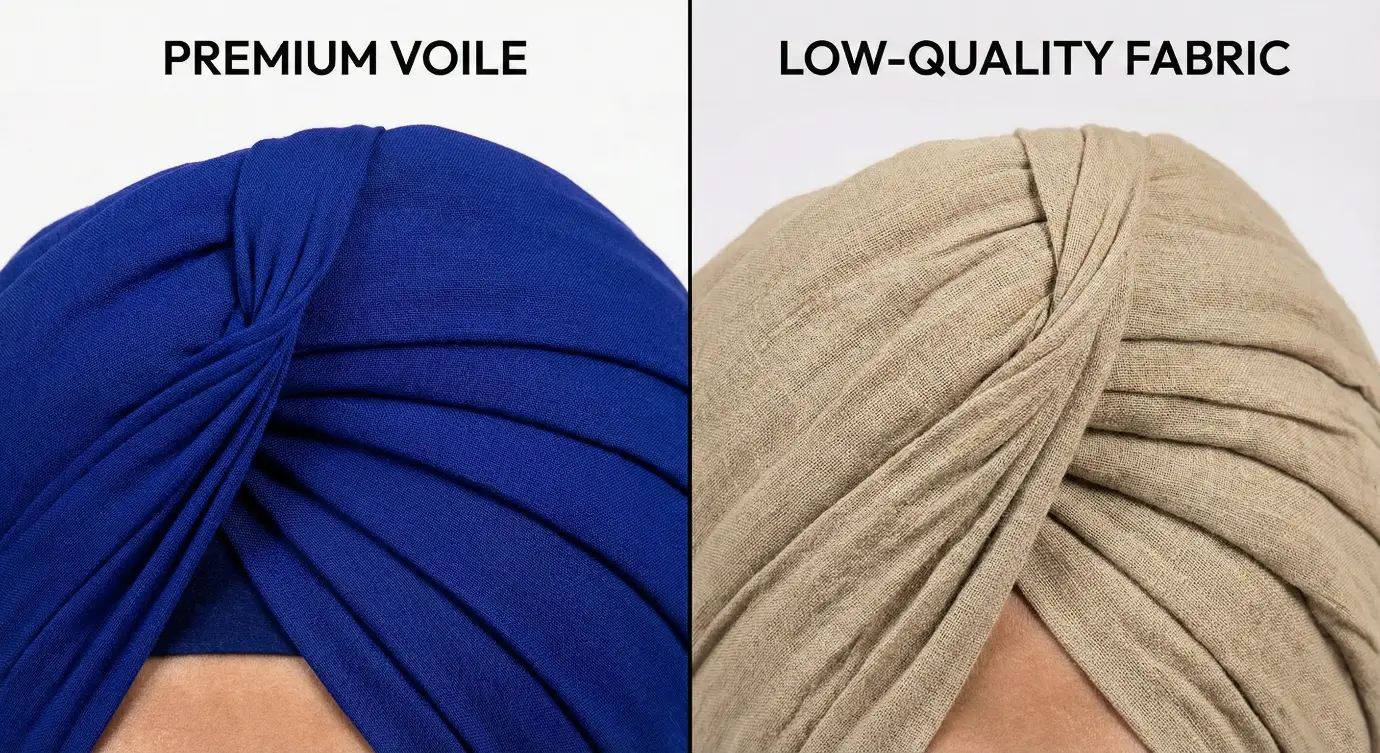
The fabric quality of a turban is significantly important as it determines both comfort and visual presentation. A turban fabricated from a low-grade fabric might initially look acceptable when tied, but become unshaped and unusable after only a couple of hours.
- Sharper Larhs versus Soft Folds: Larhs are the crisp layers observed on your turban. Fabrics such as Full Voile (or Voile) and Rubia Voile provide for crisp, sharp layers that remain uniform or in place. Lower quality fabrics may slip or fold unevenly, leaving the turban appearing messy.
- Colour Saturation and Colourfastness: Fabrics that use the best quality dye to create colour have extremely rich colour because they have been washed many times. For instance, a navy blue or maroon turban made from a high quality Certified Fancy Fabric will keep its beautiful colour, whereas cheap fabrics will often fade much quicker and appear very dull.
- Thickness and Tying Stability: A thicker fabric will help keep the turban’s shape and make it easier to tie larger turbans including Dumalla styles. A softer, thinner fabric will require additional care in folding and additional pins to hold in place during long-term wear.
Common Mistakes People Make When Choosing Turban Fabrics
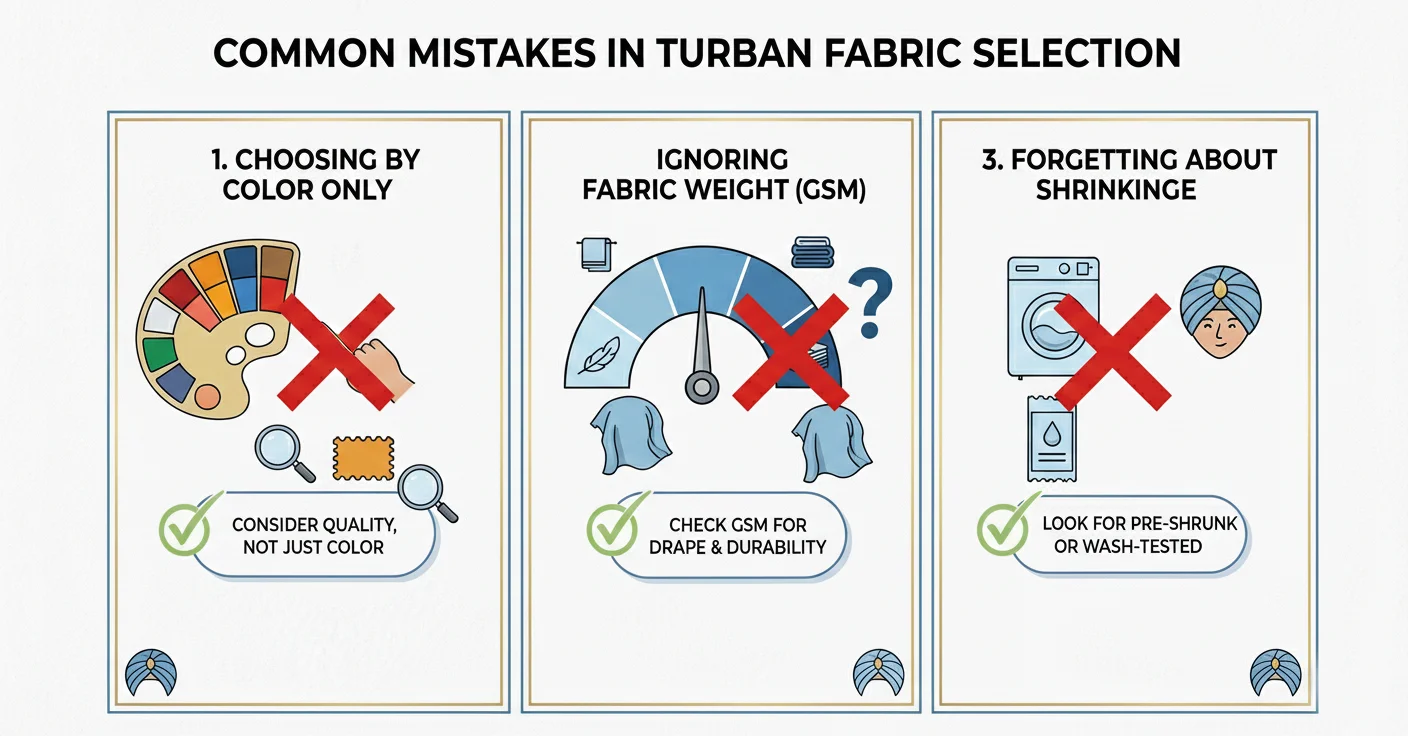
People tend to select their turban primarily because of its color and do not consider many other factors that may affect the level of comfort and durability for them. The following is a list of common mistakes made while choosing a turban:
- Turban Selection by Only Color: Brightly colored Turbans may look very nice and be attractive, but will likely not be as comfortable as turban colours that are worn for longer periods. Therefore, the level of comfort should take precedence over which colour(s) you decide to select your turban(s) based on.
- Neglecting to Look up GSM (Grams per Square Meter): GSM is the weight of the fabric, which is important for selecting a turban. A turban too heavy in the summer will cause you to be uncomfortable and too light will lead to it losing its shape quickly.
- Not Considering the Fabric’s Pre-Shrink/Wash Nature: Certain fabrics will shrink when washed, making it possible that your turban may not fit properly after washing. Many premium-quality turbans have been pre-washed prior to sale to avoid this issue.
- Fabric Categories: The quality of fabrics can be arranged on a continuum from low through medium-quality to premium-quality fabrics. Premium-quality fabrics are generally soft, will not deteriorate as quickly, and will hold their colour better than lower quality fabrics.
Fabric Myths Debunked by Sikh Accessories’ Experts
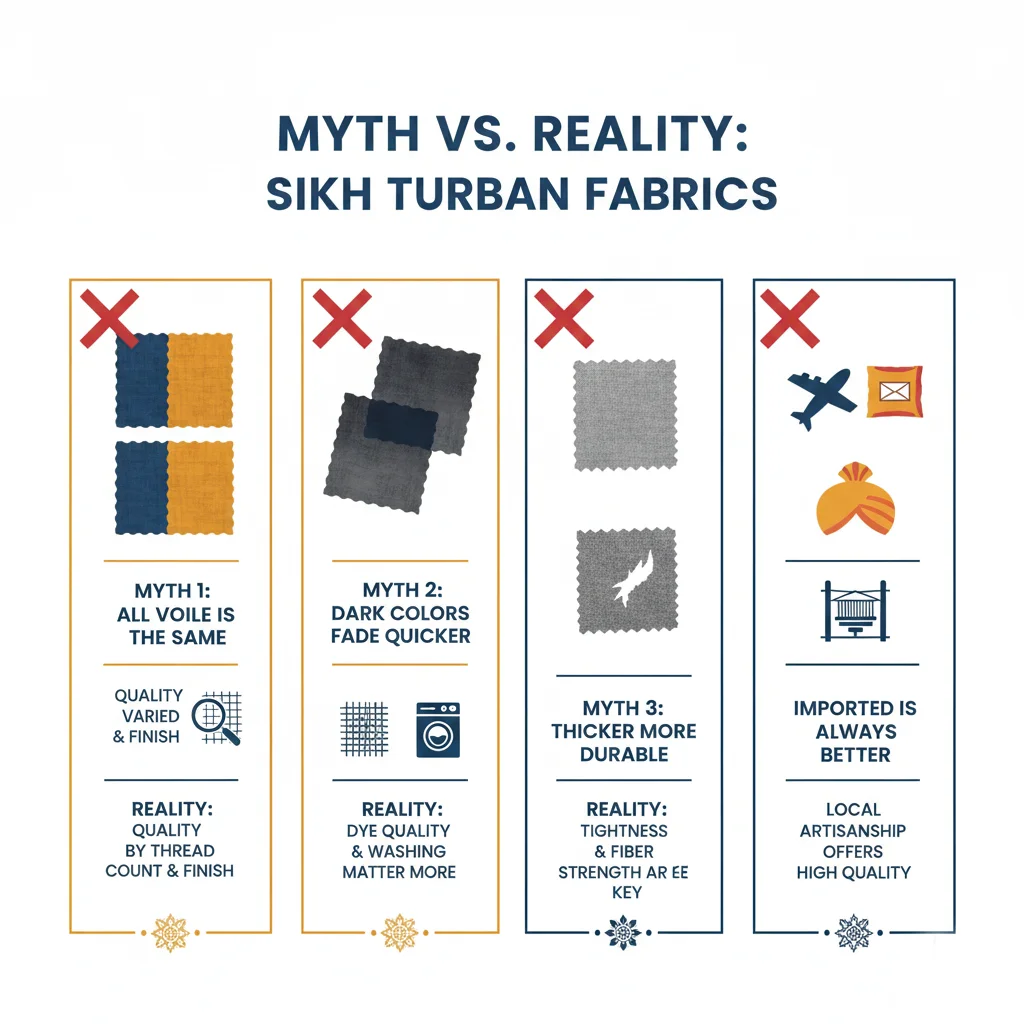
There are several misconceptions regarding Turban Fabrics, which are incorrect:
- All voile fabrics are alike – in actuality all voile fabrics differ in regard to softness, thickness, and durability. Full-voile will be softer and lighter than semi-voile, which will be somewhat stiffer than full-voile fabric.
- Dark colours fade quicker – The use of quality dyes is more important for maintaining colour vibrancy than whether or not the colour is light or dark. Fading typically occurs on cheaper fabrics.
- The thicker the turban, the longer the durability – the durability of the turban is determined primarily by the weaver’s skilfulness and the amount of time put into the weaving process, and not predominantly by the thickness of the turban.
- Imported fabrics are always superior – Indian mills have cultivated a level of knowledge and skill over the course of many generations in weaving fabrics, thus giving them the advantage of producing many Indian fabrics that are actually softer and more durable than the imported equivalents.
How Sikh Accessories Tests Every Fabric Before Listing It
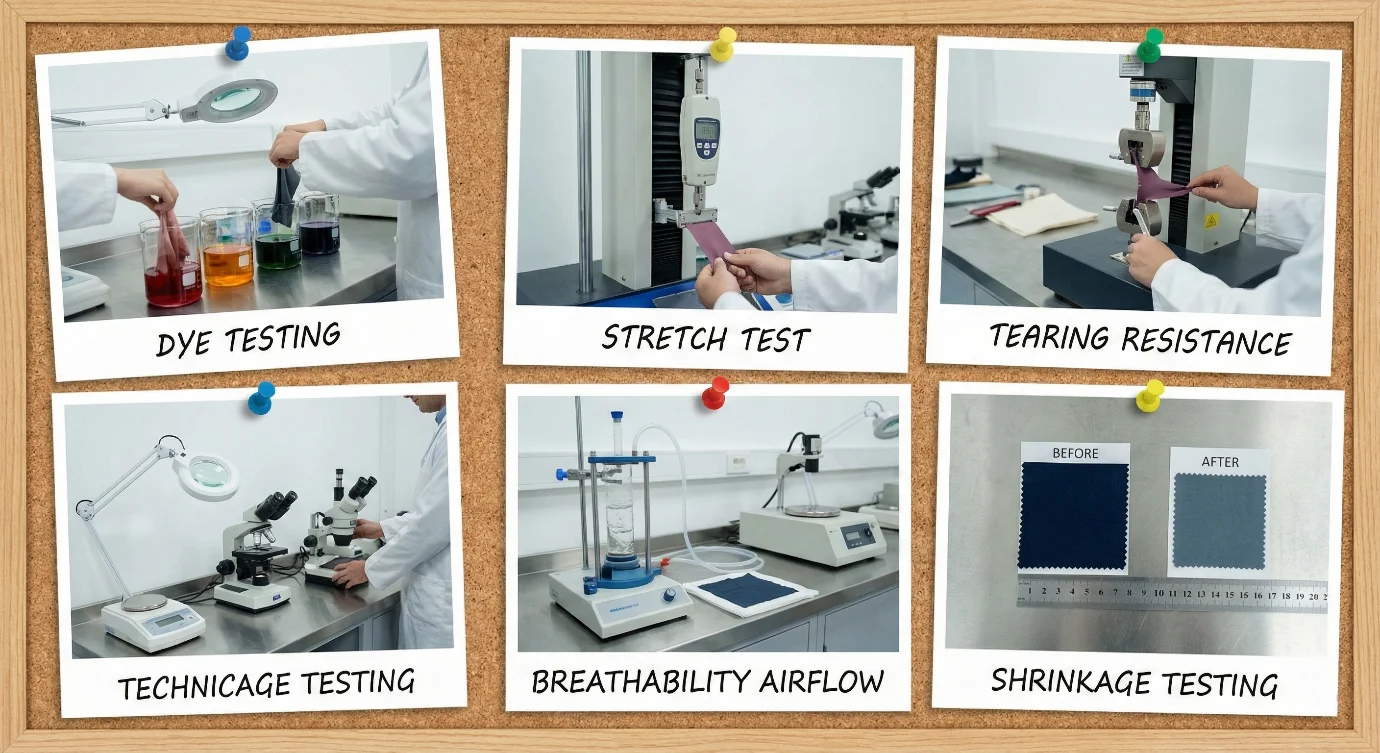
Certain materials may not be appropriate for use as turbans. At Sikh Accessory, the quality of each fabric is examined closely for it’s comfort, durability, and longevity.
Dye test: The dye test allows us to soak the fabric in water repeatedly to check whether the colour of the fabric will run and fade over time (which is especially important for turbans); if a turban goes through a few washes and loses most of its colour during the initial wash, it may appear worn out or old quickly. For example, a vibrant maroon turban has been tested for dye quality and held its vivid maroon colour through multiple washing cycles.
Stretch & tear testing: Since turbans must be tied tightly (particularly Dumalla or Patiala Shahi styles), all fabrics submitted for use as turbans will be stretched and twisted extensively to ensure that they will not tear or lose their shape while being worn for extended periods of time.
Breathability test: Fabrics must also be tested for the amount of air that will flow through the fabric; breathable fabrics will provide more “cooling” of the wearer’s head and will help to eliminate the accumulation of sweat during hot weather and extended ceremonies.
Shrinkage Testing: After washing some fabrics may shrink and may cause the fabric to lose its proper fit. In Sikh Accessories, we perform pre-wash checks on our fabrics so that there will always be minimal amount of shrinkage.
Supplier Screening: All suppliers provide quality fabrics that meet the same standards. As a result, every turban ordered has a similar look and feel to the ones previously made. Therefore, by performing these steps, Sikh Accessories provides turban customers with a soft, neat and long-lasting product, compared to local markets.
What Makes Sikh Accessories’ Fabric Superior to Local Market Options
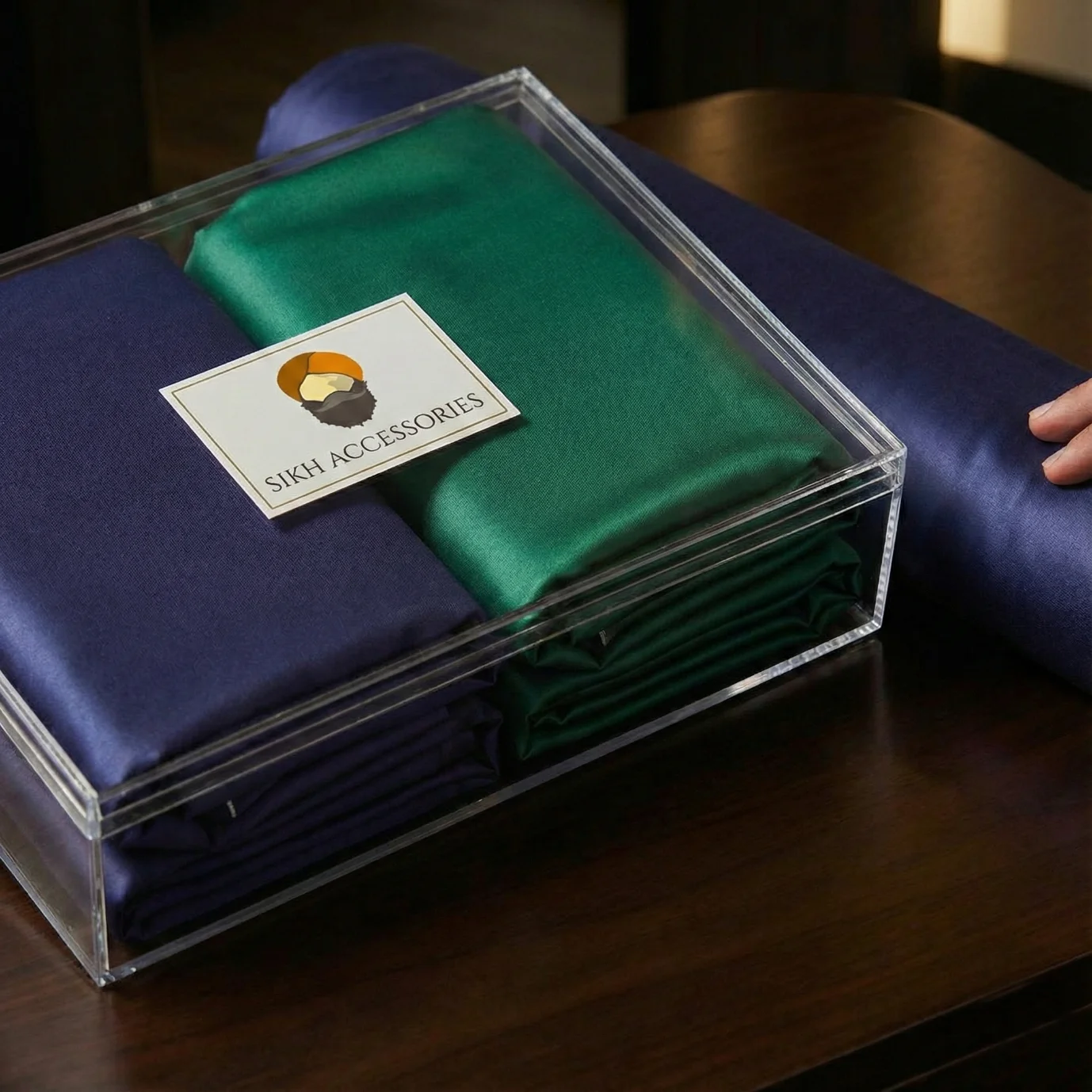
Many turban fabric customers buy from local retailers only to find that the fabric does not hold up to expectations (e.g., slippage and fading), may be rough to the touch, etc. Sikh Accessories offers a premium-level product and consistent quality differentiates them from others in the market. Here are some examples of how Sikh Accessories achieves this goal:
- Authentic Thread Count Verification – Thread count measures thread density per square inch. A higher thread count results in a softer, smoother fabric. Sikh Accessories checks all of our fabric rolls for softeness (consistant softness).
- Each Batch is Consistent – Most local fabric markets will sell fabric that varies in quality, although Sikh Accessories provides each color and style with the same feel;
- Premium Grade Dyes – Longer Lasting Colors – The dye used to color each fabric is long-lasting and non-toxic to the skin, resulting in a brighter, fresher-looking turban;
- Smooth Finishing Process – Easier Folding & Tying – The fabric is processed so that customers will experience no difficulty in folding and tying it into a sharp larh;
- Hygienic Packaging – All of our fabrics come packaged neatly folded and in a dust free environment so they are ready for immediate usage without any cleaning or preparation necessary prior to wearing the fabric.
By maintaining high standards for quality assurance, customers receive turbans that not only look beautiful and feel of a premium quality but also will wear much longer than cheaper fabrics available in local markets.
Choosing the Right Fabric for Different Turban Styles
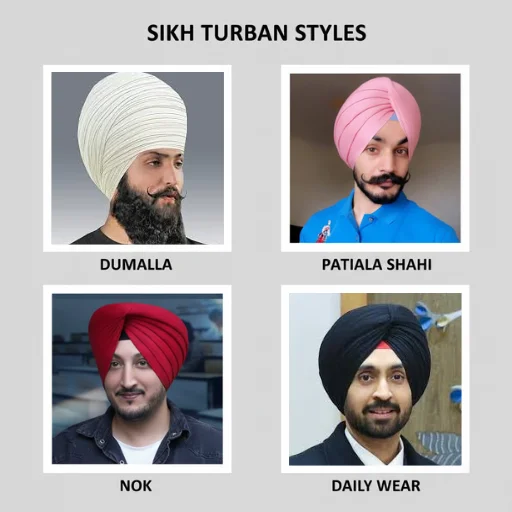
Each of the various styles of turban requires specific kinds of fabric to create their shape and decorative effects. For example:
- Patiala Shahi – Smooth and soft fabrics such as full-voile and semi-voile produce clean and neat folds. Therefore, it is important to use fabric with a smooth surface so that multiple layers can slide easily into place and form sharp and consistent edges.
- Dumalla – Due to the weight of this style, a somewhat heavier fabric is needed for greater stability than the other styles mentioned. Heavyweight cotton or cotton blends will keep the shape of the tukhir while also preventing the tukhir from slipping out of position, especially if worn for long periods of time.
- Nok – For this turban style, it is preferable to use fabric that allows for crisp edges and that is not too bulky. Hence, lightweight voile or malmal is preferred.
- Daily vs Special Festivals – Generally, turbans that are worn daily will be made of light-weight breathable textiles, and those which are used on special occasions and formal occasions like a wedding will be composed of thicker more structured materials to keep the turban’s shape.
When an incorrect type of fabric is selected, the result will be poor fit, movement from the intended position, as well as uneven folds. For this reason, knowledge of the various styles of turbans, along with the types of fabric available for each style is essential when either purchasing or making turbans.
Fabric Care Secrets Shared by Sikh Accessories
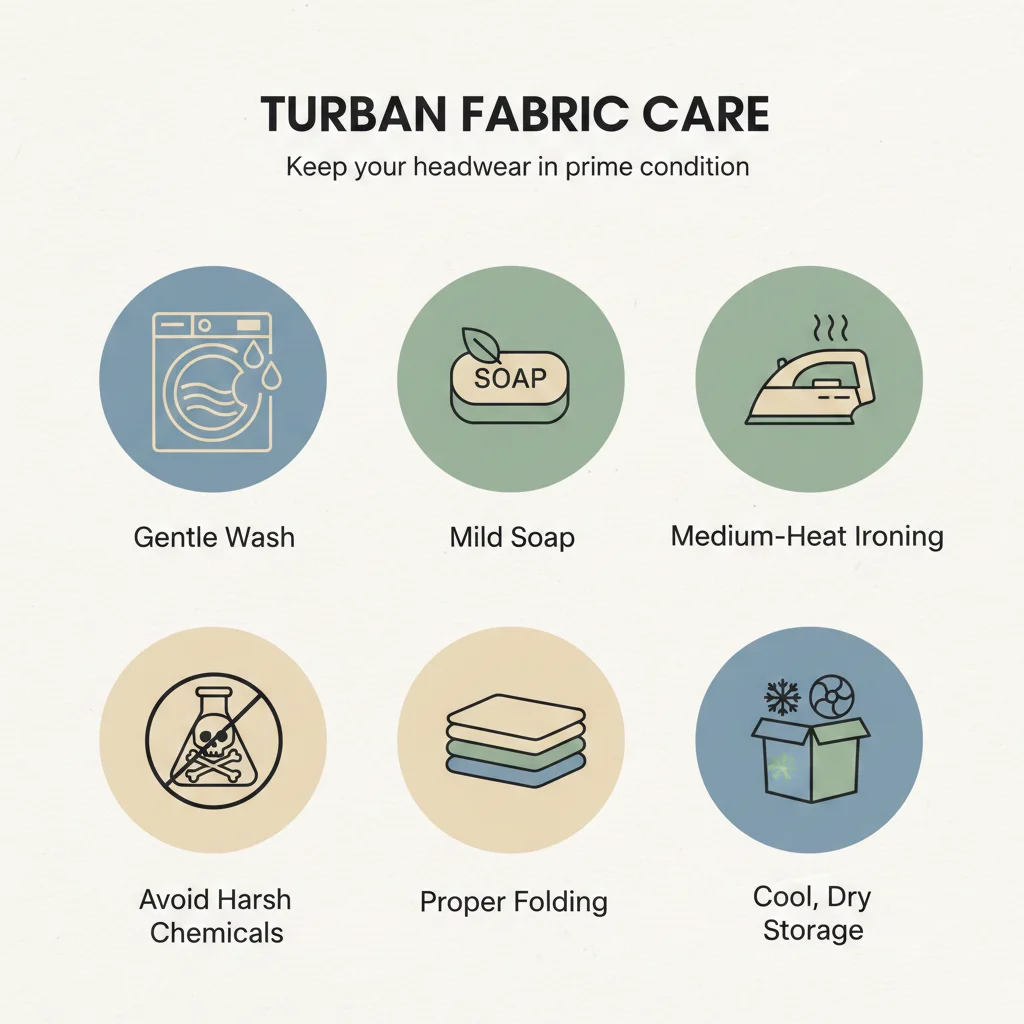
Using the right care methods for a good piece of fabric will help keep it looking and feeling good. There are many ways to care for your turban, and Sikh Accessories has put together a list of those care methods:
- Washing – Cold Water & Gentle Soap No Vigorously Scrub – Anything Abrasively Scrubbing Will Damage the Fiber’s Fabric – Direct Example; When Soaking A Delicate Full Voile Turban; Keeping The Turban Soft By Using A Mild Soap And Lukewarm Water.
- Ironing– Soft Fabrics Require a Medium Heat Setting to Be Ironed. Hot irons create hard creases for the more formal style, however, if too high of a heat is used, the delicate fibers may become damaged.
- Soft Fabric Maintenance – Do Not Use Harsh Chemicals or Detergents with Bleach. The strong chemical compounds in a heavy-duty detergent will remove the luxurious feel of the soft fabric (such as full-voile).
- Storage – When Storing Your Turban, Carefully Fold It Up and Store It in a Dry, Cool Area to Prevent Mold, Creasing, And Fading Due To Humidity, etc. Utilizing Fabric Storage Bags/Boxes, Will Also Provide Protection for the Turban, and Extend His Lifespan.
If you follow these care tips, your turban will be more attractive, feel softer, and be more durable.
Behind-the-Scenes: The Journey of a Sikh Accessories Turban Fabric
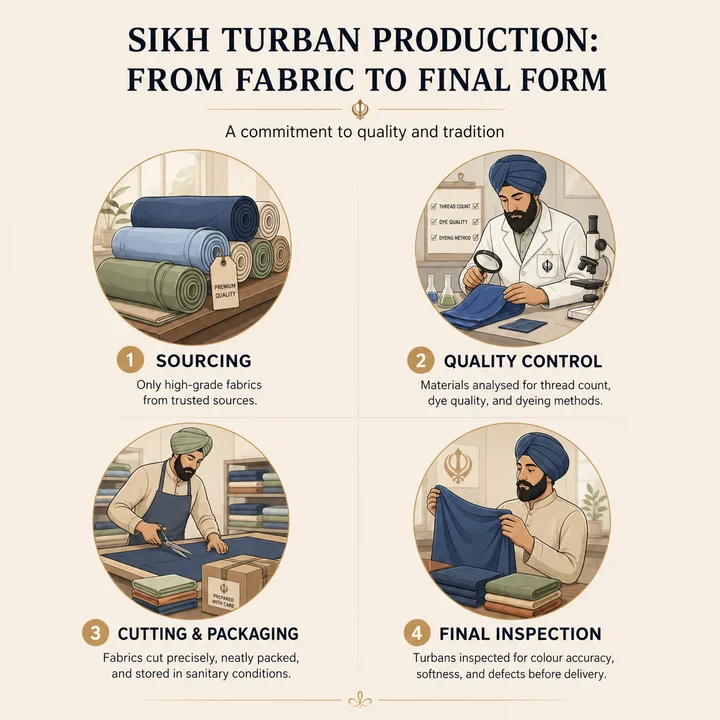
Sikh Accessories turban has a history behind every turban before it reaches your hands.
- Sourcing: Only high-grade fabrics from trusted sources.
- Quality Control: The materials used for weaving and dyeing are analysed for their quality (thread count; dye quality AND method used).
- Cutting and Packaging: These fabrics are cut into precise lengths; prepared for shipment in a neat manner; (and) stored in sanitary conditions.
- Final Inspection: Each turban will undergo a visual inspection to verify they are accurately coloured (in accordance with the design), soft, and free of defects, before being sent to customers.
This thorough process provides for a superior quality turban than others offered in the local marketplace through providing clean, finished, properly coloured (per designs), and properly fitted turbans.
Expert Recommendations: The Best Fabrics for 2026
The experts at Sikh Accessories for 2026 have identified the fabrics that are trending and performing the best for the year. These fabrics are:
- Trending Fabrics: Soft full-voile and lightweight cotton are trending in modern turban styles.
- Best fabrics for kids: To promote comfort, the best fabric for children should be soft and lightweight, so it is gentle against their sensitive skin; therefore, a fabric designed primarily for comfort should meet this guideline.
- Best for long hours: Turbans are worn all day long by many people, so a fabric that allows for airflow to help prevent excessive sweating will allow for the wearer to remain comfortable over an extended period of time.
- Best Fabric for Fashion Style: Fabrics that can be pressed into sharp fold lines and colours will be used at special occasions such as weddings, special events or ceremonies.
All individuals who follow these recommendations will find the most fashionable and comfortable turban, and that they will continue to look and feel their best.