
Table of contents
- Turban Colour Matching Guide: Best Colours by Kurta, Skin Tone & Occasion
- Introduction: Why Your Turban Colour Matters More Than You Think
- The 3 Golden Rules of Turban Colour Matching
- Best Turban Colour with White Kurta Pajama
- Complete Turban Colour Matching Chart (Outfit by Outfit Guide)
- Best Turban Colour by Skin Tone
- Advanced Storage Techniques for Longevity
- Turban Colour by Occasion
- Trending Turban Colours in 2026 - 2027
- Quick Summary: The 5 Rules to Remember
- Frequently Asked Questions (FAQs)
Turban Colour Matching Guide: Best Colours by Kurta, Skin Tone & Occasion
Introduction: Why Your Turban Colour Matters More Than You Think
Your turban is not just a piece of cloth. It will be the first thing which people see about you and sets the mood for everything else in your look, including your kurta, shoes and accessories.
However, most people choose their turban colour out of habit or by simply picking out whatever colour looks good on the shelf. The result is an outfit that works almost – a fantastic kurta being covered up, and a wedding outfit just missing the mark.
To sum it up, selecting the right colour for the turban is a craft that you can cultivate. Once you do, you will have the ability to create outfits where everything points to an intentional, sophisticated, and powerful end result.
This handbook will cover everything from what colours go with what kurtas to how skin tone will affect your colour selection, the best colours for all of the occasions you find yourself at, and the new colours and shades making waves for 2026-2027. At the end of this book, you will fully know what colours you should be looking for and where to locate them.
To answer the quick question: The best turban colour for you is the one that either contrasts well with your kurta (i.e. navy turban + white kurta), complements your kurta from the same colour palette (i.e. rust turban + brown kurta), or picks up an accent colour from an outfit that is printed.
The 3 Golden Rules of Turban Colour Matching
Fashion design does not require a degree. You need 3 principles and the confidence to use them!
Rule Number 1: Contrast
Contrast is the pairing of colours that sit opposite each other on the colour wheel. The result is sharp, high impact photography and commanding visual interest in a space.
Examples:
- Navy blue turban + white or cream kurta;
- Deep maroon turban + ivory or off white sherwani;
- Golden/mustard turban + black or charcoal kurta.
Contrasting colours are a great way to dress for weddings and formal occasions, or any occasion where you want to impress.
Rule Number 2: Complement
Complementing is when you use a turban that is in the same family as what you are wearing; as a result of this you create a sophisticated/harmonious look.
- Rusty coloured turban + burnt orange/brown kurta
- Olive green turban + Khaki/beige outfit
- Royal blue turban + light blue/grey shirt
This type of look is perfect for everyday wear, work environment, and/or low maintenance family gatherings
Rule Number 3: Coordinate
If wearing clothes with prints, such as floral kurta, checked shirt and patterned sherwaani, take one of the accent colors from that article of clothing and use an identical colored turban to coordinate with those clothes.
- For example, you would have a blue & white polka dot kurta, then your turban would be royal blue or navy.
- Or, if you wore a green & gold embroidered sherwaani, your turban would be either mustard yellow or gold.
- If you had a red & cream polka dot kurta, your turban would also be either dark maroon or ivory.
This method works particularly well for festive and printed outfits, and is a simple way to look intentionally put-together
Best Turban Colour with White Kurta Pajama
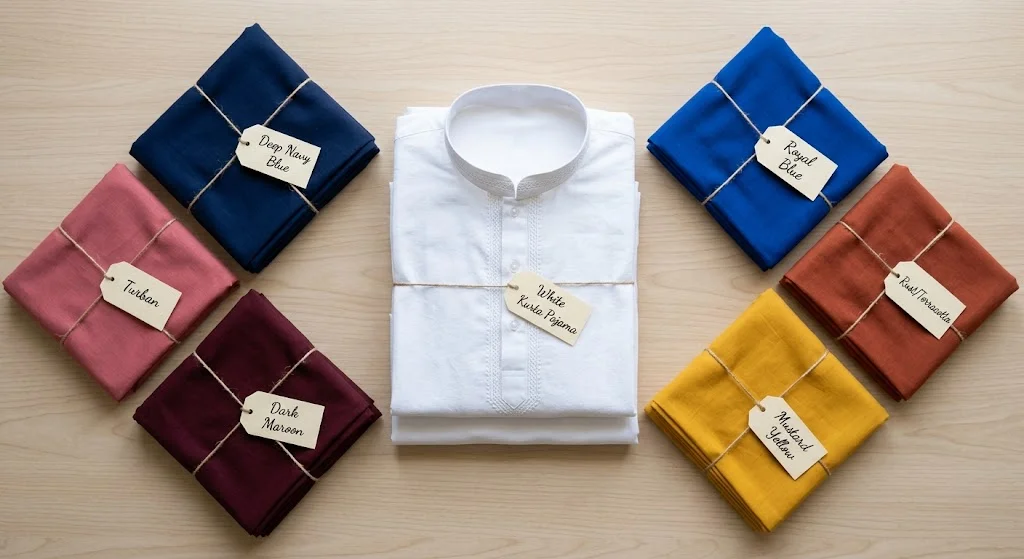
White is the most common base color in an Indian wardrobe – the good news is that nearly every turban color pairs well with white; however, some combinations stand out more than others.
Navy Blue Turban + White Kurta
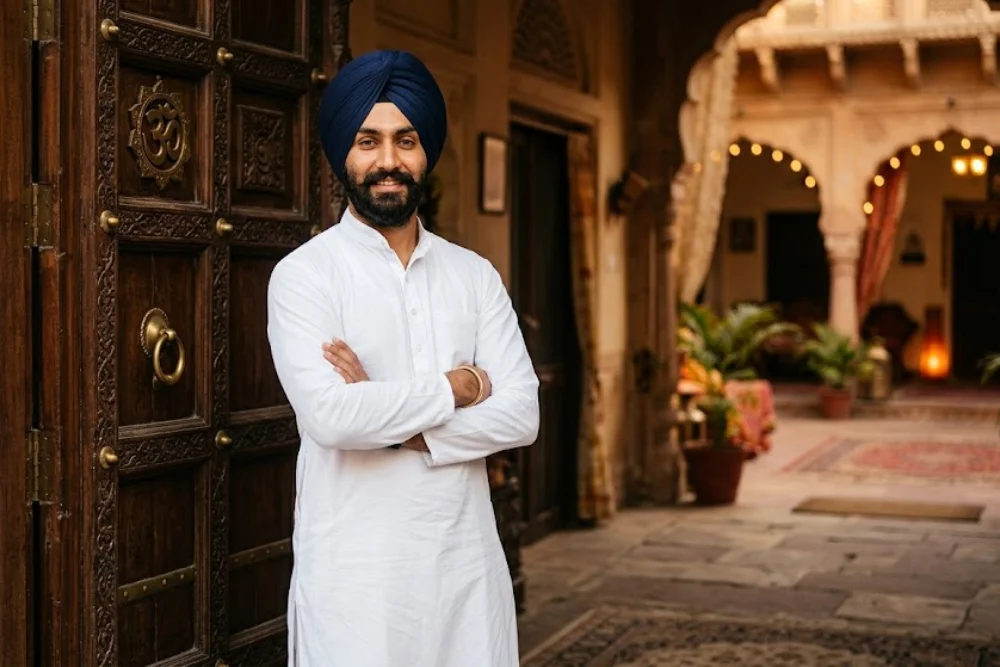
An all-time favourite, this combination can be worn at any kind of gathering whether it is a casual or a formal event throughout the year. You will achieve a sophisticated look without getting attention brought to yourself; this is one of the best examples where you can create an elegant look with a simple outfit using a little colour.
Best fabric for this look: Full Voile or Heavy Rubia Voile – both fabrics are suitable for showcasing navy blue and white together beautifully.
Royal Blue Turban + White Kurta
An increasingly popular choice among young Sikh men, royal blue has much more vibrancy than navy blue and looks fantastic when worn in the daylight or during special occasions.
Mustard / Kesari Turban + White Kurta
A classic color combination steeped in Sikh culture and history. A great way to pair the traditional, warm gold tones of mustard and kesari with white is through this combination, making them a great match for any Gurpurab celebration or wedding ceremony and for other religious celebrations.
Rusty and Burnt Orange Turbans + White Kurta
These two warm, rich earthy colours look good with white in the winter season (especially during night events) and at major family celebrations such as weddings and Christmas parties.
Wine Turban + White Kurta
Wine-coloured turbans are growing in popularity thanks to their deep, sophisticated tone — richer than classic maroon but still versatile. They pair beautifully with white for evening events and have been one of the most popular turban colour choices over the last two years.
Complete Turban Colour Matching Chart (Outfit by Outfit Guide)
This chart will help you quickly figure out which colours of turbans work for the kurtas or clothes you already own.
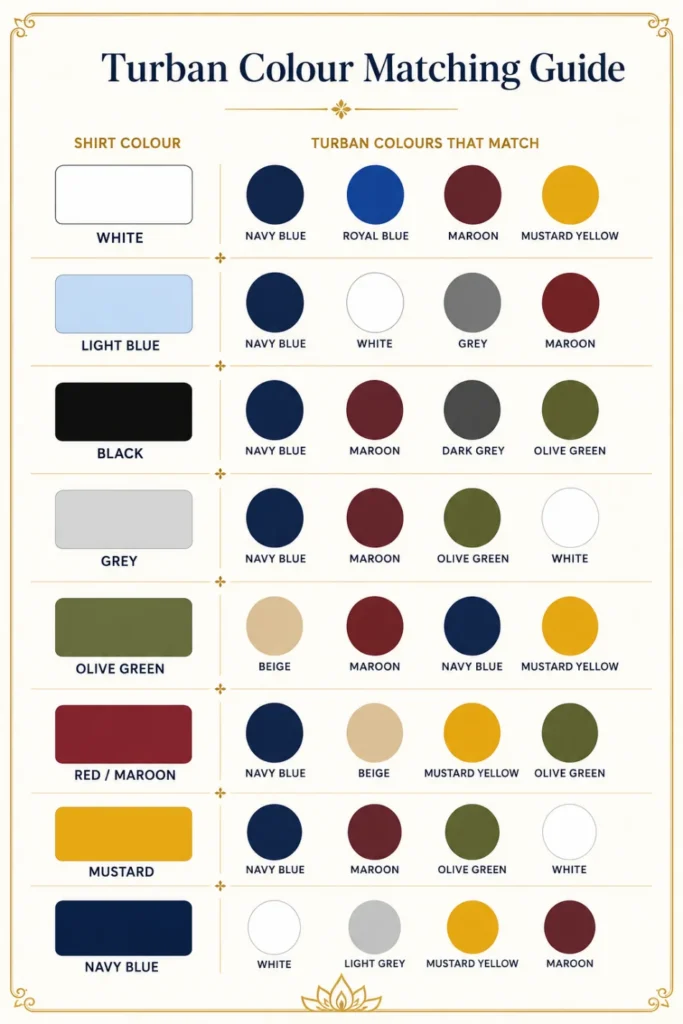
| Kurta or Outfit Colour | Best Turban Colour | Colour to Avoid |
| White or Cream | Blue Navy, Royal Blue, Maroon, Kesari, Mustard Orange | Red Pale Yellow and Off White |
| Light Blue | Gray, Peacock Blue, Olive Green, Ivory and Light Blue | Hot Pink and Bright Red |
| Black | White, Maroon, Red, Golden, Royal Blue | Black and Dark Brown |
| Gray | Red, Brown, Maroon, Navy and Dark Green | Light Gray and Silver |
| Dark Green or Olive Green | Brown, Mustard, Rust and Cream | Dark Green or Olive Green |
| Red or Maroon | Cream, Ivory, Golden and Dark Navy | Orange and Pink |
| Yellow or Mustard | Olive Green, Mustard, Brown and Rust | Yellow and Bright Lime |
| Blue Navy | White, Ivory, Golden, Rust and Light Blue | Black and Dark Brown |
Note: The above guidelines are simply just that: guidelines! When wearing an outfit it is important to feel confident, rather than worrying about matching up with any specific chart.
Best Turban Colour by Skin Tone
The question of what colour is best for your turban is one of the most often searched in our data from Google’s Search Console (GSC) and we get asked it all the time for good reason. The same colour of turban may look stunning on one person and dull or flat on another based purely on skin tone. Here is a basic guide to the best colour for your turban based on your skin tone.
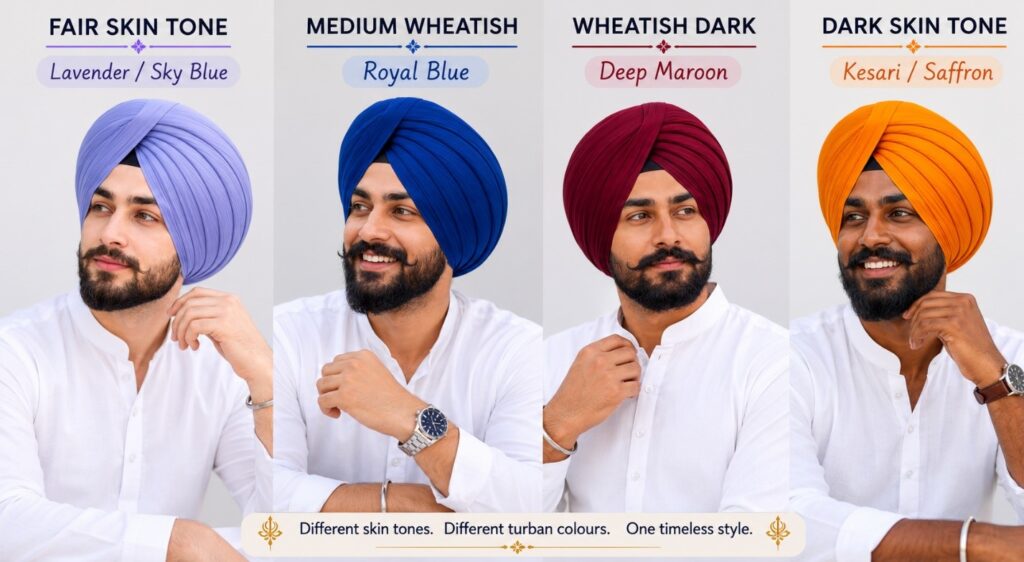
| Skin Tone | Most Flattering Turban Colours |
| Fair / Light | Pastels, Sky Blue, Lavender, Soft Pink, Olive, Navy |
| Wheatish / Medium | Royal Blue, Mustard, Rust, Maroon, Forest Green, Peacock |
| Wheatish / Dark | Rich Jewel Tones – Deep Maroon, Gold, Emerald, Cobalt Blue |
| Dark / Deep | Saffron/Kesari, Royal Blue, Bright White, Warm Gold, Deep Red, Peacock Blue |
Why Does Skin Tone Impact Colour of Turban?
Darker turbans tend to visually retract against darker skin tones giving the wearer a duller appearance. Bright, warm, and vibrant colours contrast and bring a bright face forward. Fair skin can carry both soft pastels and deep shades well. However, very light pastels worn without any contrast (e.g., pale pink with pale skin) can look washed out — pairing a pastel turban with a darker or more saturated outfit keeps the look sharp.
The general rule is that the more contrast (dark vs light) between your skin tone and turban colour, the better the overall effect.
Turban Colour by Occasion
A turban is chosen according to the occasion on which it’s worn. Below is a list of colour choices based on the occasion you’re wearing a turban for.
Everyday Wear
Choose neutrals that coordinate with most of your wardrobe to wear every day. Navy blue, grey, olive green & earth tones are the best colours for everyday wear. For fabric, full voile or malmal offer the most comfort for everyday wear.
Professional Settings
In a corporate setting, most notable for Sikh men due to jobs within corporates and business’s, should use subtle and sophisticated colour schemes throughout the workplace; Therefore, navy, charcoal grey and dark burgundy are colours that convey confidence and professionalism while still remaining discreet.
Sikh Wedding (Groom)
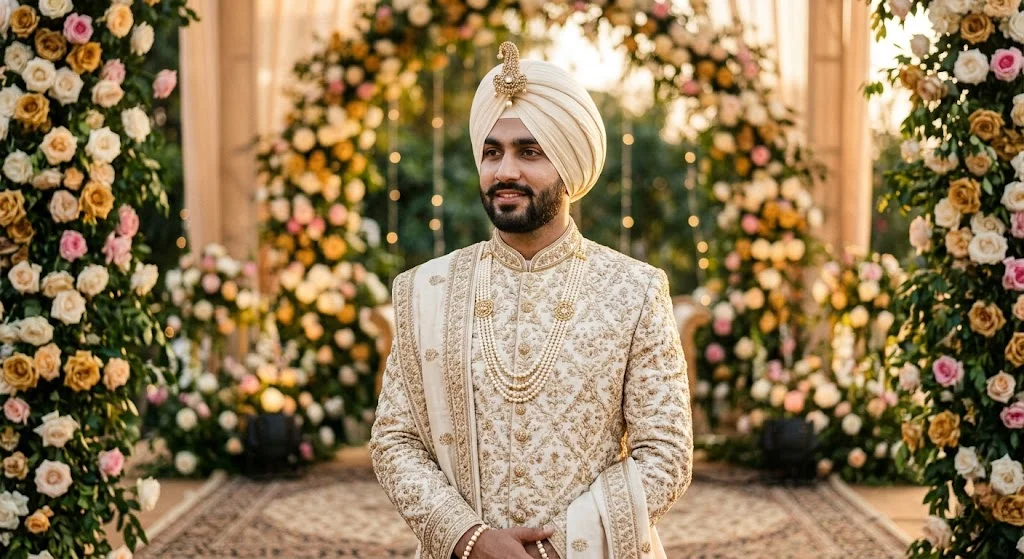
The groom’s turban is one of the largest decisions made at a Sikh wedding. Some of the traditional colour choices that can be made are:
- Cream/Ivory – classic colour, elegant, goes with any sherwani
- Shahi Pink/Rose Gold – this colour is increasingly popular at a Punjabi wedding
- Gold/Mustard –traditional wedding colour; particularly for Anand Karaj
- Red/Royal Red – this colour is a bold colour, traditionally considered auspicious
- Deep Maroon – versatile colour which goes well with cream or beige sherwanis.
To view our entire wedding turban collection please browse the complete wedding turbans section for premium fabrics made for wedding occasions.
Gurudwara and Religious Events
At the Gurudwara or Sikh events, colors hold special meaning. Saffron or orange shows courage and sacrifice, while purity is shown by wearing white. Dark blue represents the teachings of the Nihang Singh. So, these colors aren’t just chosen randomly – each one tells a story. All these colours are suitable for religious observances.
Trending Turban Colours in 2026 - 2027
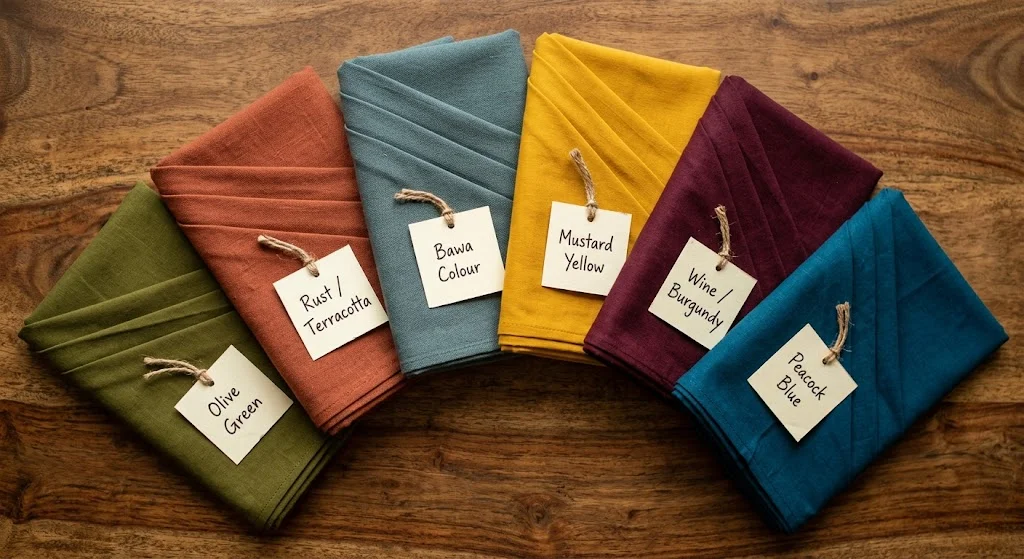
Turban colours go in and out of style, just like the rest of the fashion world. This article outlines which of the current trending turban colours are gaining traction within Sikh communities worldwide.
Olive Green — The Quiet King of Colours
Olive green has been steadily gaining popularity with its ability to coordinate equally well with white, beige and earthy tones, look professional at work and photograph at its best outdoors. For the last year and a half, olive green has continued to be one of our top selling turban colours.
Rust and Terracotta — Earthy Warm Tones
Rust and terracotta remain popular colours across all Indian fashion lines, not only in turbans. They are both being used extensively for autumn and winter occasions due to their warm earthy tones and look amazing with dresses in cream/ivory colours.
Bawa Colour — The Combination of Sikh Youth
Bawa colour refers to a distinctive medium grey-teal shade that has become popular among younger Sikh men, especially those engaged in Gurdwara sevā or following traditional practices. One of the latest trends among turban wearers, the term “Bawa colour” was coined by Sikh youth themselves. Over the last 12 months, searches for the bawa colour turban have increased significantly.
History of Mustard and Gold: Combining the Old with the New
Punjabi fashion has always included mustard; this season it is particularly popular. The latest version of mustard is a deeper, warmer colour than classic kesari (closer to gold than orange), which means it goes well with both white and olive-coloured kurtas.
Wine (Burgundy) With White
Wine (burgundy) is a newer colour of turban that is seen more and more over the last year; it is considered to be more elegant than maroon but not as bold as red, making it perfect for evenings, winter weddings, and at work.
Peacock Blue
Peacock blue is a bright blue-green colour that complements warm and dark skin tones and has become popular for everyday use as well as for festive occasions. It looks awesome in photos!
Quick Summary: The 5 Rules to Remember
- A white kurta is the perfect versatile base, navy, rust, mustard, and maroon will work fabulously together.
- Use contrasting colour pairings (opposite colours) for maximum impact, or complementary colour pairings (same colour family) for a harmonious, everyday look.
- For those with dark skin tones, using very bold saturated colours is the way to go (i.e., saffron, royal blue, warm gold and deep red).
- The most popular colour options for weddings are ivory, shahi pink, gold and burgundy.
- The top trending colour(s) right now include, but are not limited to – olive green, rust, bawa, mustard, bordeaux and peacock blue.
You can shop over 1000 colors of turbans at Sikh Accessories, which is India’s premier Sikh store that has been in business since 2017 and is located in Amritsar, India with fast shipping throughout all of India as well as internationally.
Frequently Asked Questions (FAQs)
Best turban colors to wear with white kurta pajama are navy, royal blue, mustard, rust colored, and maroon. The combination of navy and white is the most classic and universal of all combinations. For weddings, ivory, shahi pink, or gold turbans paired with a white sherwani are among the most traditionally preferred combinations.
Olive green is the most popular color in 2026–2027 for turbans. Other popular colors include rusty/terracotta, bawa, mustard/gold, burgundy/red wine, and peacock blue. Olive green has seen increased growth across all customer age ranges.
Take one accent colour from the print and use it to match your turban exactly. An example: If you have a blue and white print kurta, the best matching turban colours will be navy or royal blue. For solid colour kurtas, either a contrasting (opposite) or complementary (same colour family) match will be very effective.
A Sikh groom traditionally wears a turban in ivory/cream, shahi pink, gold/mustard or deep maroon. Royal red is good for auspiciousness as well. The turban should match the sherwani, ivory turbans tend to suit all sherwani colours; and the current trend for modern Sikh weddings is to wear matching turban and sehra.
The bawa colour is a medium grey-teal colour which has been growing in popularity among younger Sikhs and people continuing to practice traditional Sikh customs. It indicates seva and devotion; over the last couple of years it has been one of the fastest-growing colours of turbans.